Commissioned by the ICA in London for the princely sum of £150 Chemical Wedding was devised by Matt Adams, Niki Jewett, Will Kittow and Ju Row Farr.
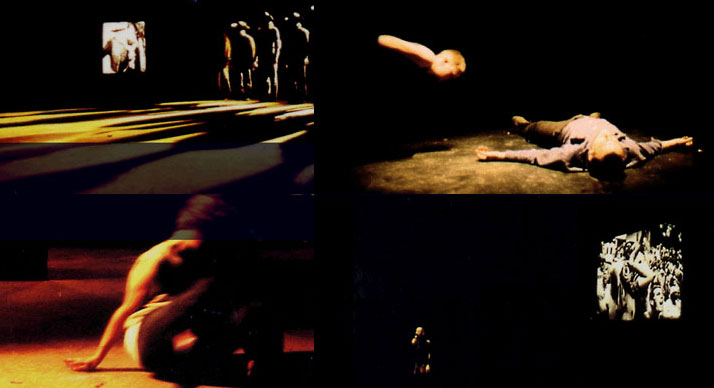
The piece explores the conflict between viruses as a reality and virus as a metaphor in the age of HIV/AIDS. A fiercely physical piece in which performers struggle with one another, with piles of medical tomes and with the audience themselves. Throughout, two video screens regurgitate AIDS paranoia, body horror films and a hexagonal map of “viral” connections between phrases and ideas. For example, the possible links between the movie Aliens, the idea of plague and government policy steadily spread across the screen.
The movement of the audience around the space itself takes on the form of a mutating organism, dividing and reuniting. This reaches its apex when spectators are asked to move into coloured pools of light to indicate their response to a series of questions. Red indicates yes, blue means no and those with no answer move into the white light. Performers count the number in each pool and this information is entered into a word processor, printed out, photocopied and handed to the public as they leave. Questions such as “Have you ever had a verucca?” are recontextualised on the print out: “A verucca is a virus”.
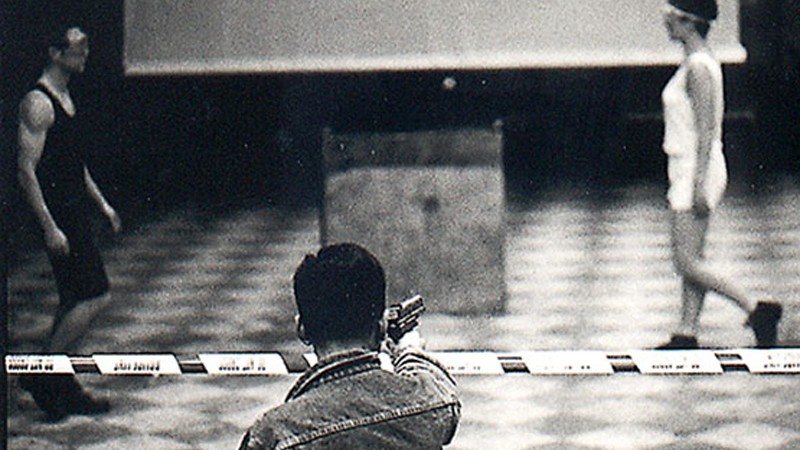
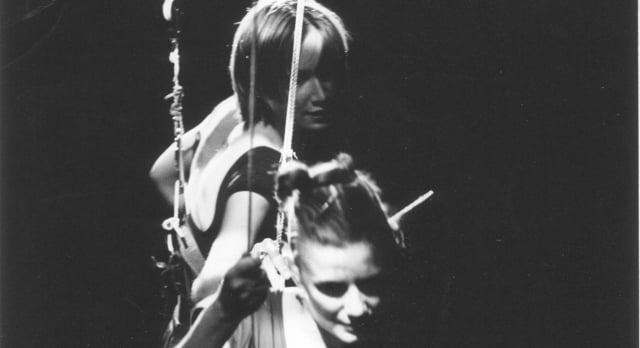
The culmination of the work is two entropic systems at cross purposes with one another. Two women in harnesses connected to a pulley system use long spoons to fill each others buckets with sand. The weight of the buckets through a gear system gradually lifts them into the air so that they are unable to reach the sand. At the same time a man in a room lies on the bed smoking and then does exercises while observed by a video camera through a window. A second man on the other side of the performance space uses the video feed to map the room and the position of the man in it by drawing in chalk on the floor. His call of “Can you see him now?” is answered by the two women according to whether they have sand on their spoon. As their system collapses so does his. Throughout a driving score by Michael Nyman steadily rises in volume to drown out the performers before they collapse from exhaustion.